The defeat is collective. The innocence is presidential.
Hegseth faces the reckoning, Rubio reportedly eyes the exit and Vance discovers the post-Trump future. Responsibility is suddenly Washington’s least popular portfolio.
The FaultLine Desk · Published 5 November 2026 · Sources checked 5 November 2026
Source date: 4–5 November 2026
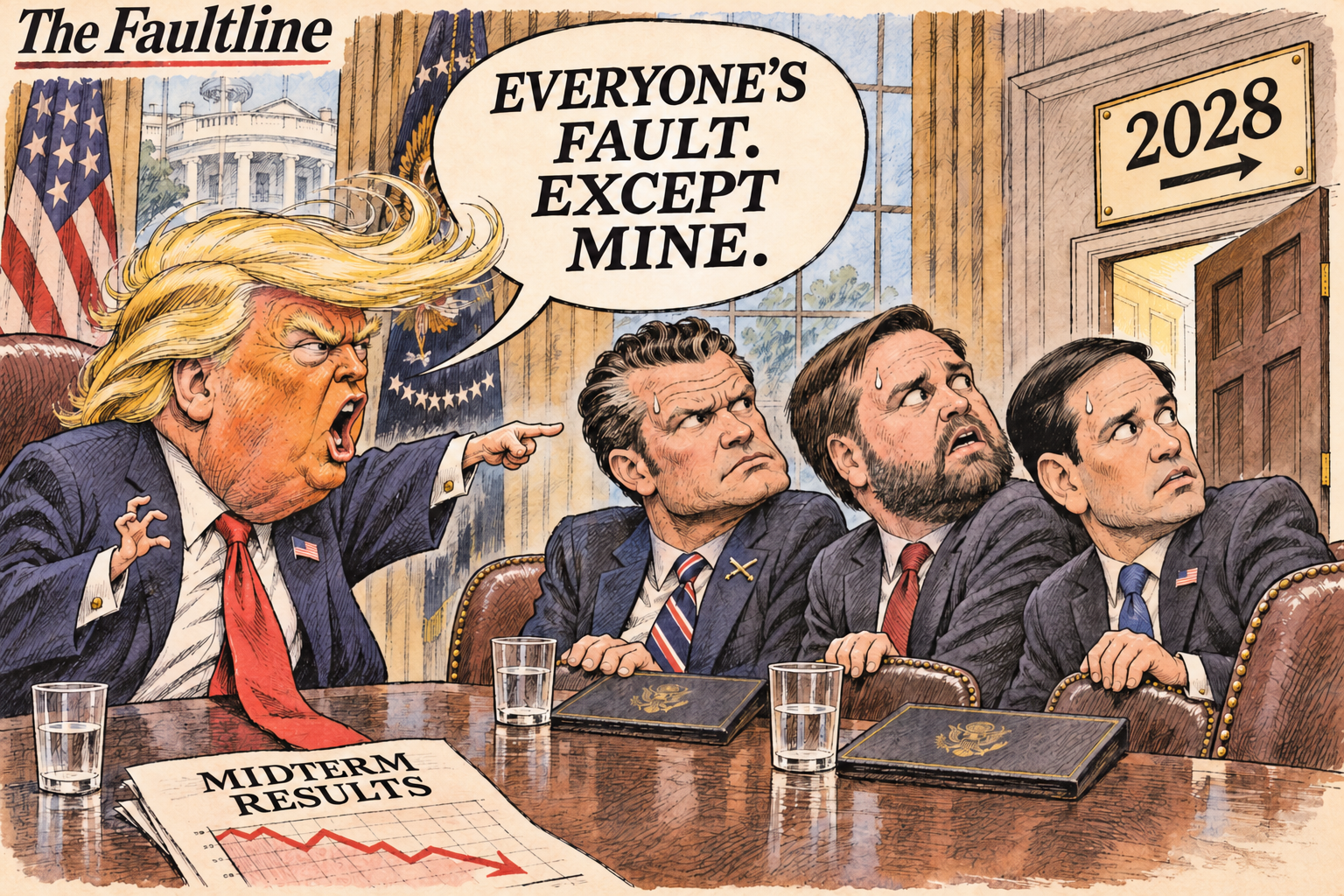
Electoral defeat has a remarkable effect on political eyesight. People who could see no alternative to the leader suddenly discover the exit, the calendar and the mistakes made by somebody sitting nearby. In the Republican Party’s post-midterm reckoning, 2028 is already functioning less as a date than as an emergency assembly point.
Pete Hegseth is the most exposed figure. The defence secretary faces renewed pressure over the Iran war and a threatened impeachment push. Yet Donald Trump has publicly said he intends to keep him. That distinction matters: this is a party searching for somebody to carry the consequences while its president still protects the man most obviously in line to receive them. The cartoon’s indiscriminate finger-pointing is satire, not a report of a cabinet exchange.
Keeping Hegseth does not resolve the underlying problem. A president cannot make military policy the expression of his personal strength and then treat its political cost as a technical malfunction at the Pentagon. Changing the official who explains a war may improve the presentation. It does not change who authorised the policy, or what voters experienced while it continued.
JD Vance’s intervention is more revealing. According to the reporting, the vice-president is making the war central to his explanation of the defeat and arguing for a renewed America First agenda, lower living costs and a reassessment of relations with Israel. Some of those questions deserve serious examination. They also deserve to be asked of the administration in which he serves. A vice-president discussing the post-Trump future is simultaneously an heir auditioning for succession and an incumbent accounting for the present. The second role cannot simply be edited out of the first.
Marco Rubio’s reported deliberations offer another version of the same manoeuvre. ANSA, citing The Independent, reports that the secretary of state is considering departure with a possible 2028 run in mind. That remains a reported possibility, not an announced resignation or candidacy. Politically, however, the incentive is plain: leave early enough to acquire distance, late enough to preserve credentials, and hope voters remember the office more readily than the decisions taken while occupying it.
The party’s struggle is therefore larger than a personnel dispute. Its prospective successors must decide what they believe went wrong. Was the problem the war itself, its conduct, household costs, the president’s judgment, or merely the inability to sell the results? Those explanations lead to different programmes. They cannot all be reconciled by pronouncing America First with renewed conviction.
Trump, meanwhile, has returned to an established explanation: the electoral system. ANSA reports that he described American elections as rigged in the Oval Office without identifying a particular vote. An accusation without a specified mechanism, supporting evidence or a clearly identified contest is not an explanation of the result. It is a way to avoid accepting the result as a judgment that requires an answer.
There is an especially sharp irony in a president attacking the credibility of the system over which his own administration presides. That does not make him personally responsible for every part of American election administration. It does make the allegation something that requires particulars rather than applause. Which election? What conduct? What evidence? The questions are less theatrical than the accusation, which is precisely why they matter.
The voters are the awkward presence in this conversation. They can be courted before an election, celebrated after a victory and recast as confused or misled after a defeat. But a party cannot learn from a loss while treating the electorate as another defective member of the team. If living costs and war helped produce the rejection, explaining why the public should have felt differently is a poor substitute for changing what government does.
The FaultLine view is that the succession race will become meaningful only when it produces an account of responsibility. Hegseth cannot absorb an entire administration. Rubio cannot resign retrospectively. Vance cannot discover independence solely in the future tense. And Trump cannot claim sole authorship of every triumph while outsourcing every adverse verdict. The defeat may be collective. Presidential innocence remains a rather more ambitious proposition.
Illustrations: original AI-generated political satire. The cabinet dialogue is invented; the spilling ballots are a visual metaphor, not evidence or an allegation of ballot fraud.
Related analysis
- Denver exposes the Democrats’ next choice: how to use power under divided government.
- Haiti’s casualty report demands a civilian test of security.
- Colombia’s child-recruitment problem cannot be outsourced to a peace process.
- In Sudan, an attack on electricity becomes an attack on water, health and food.
Sources & verification
- ANSA — Republican divisions, Hegseth and Rubio, 5 November
- ABC News — Trump says he intends to retain Hegseth, 5 November
- ANSA — Trump’s election allegation, 5 November
Desk analysis based on the sources above. Interpretations are identified in the text. Later developments may change this assessment.