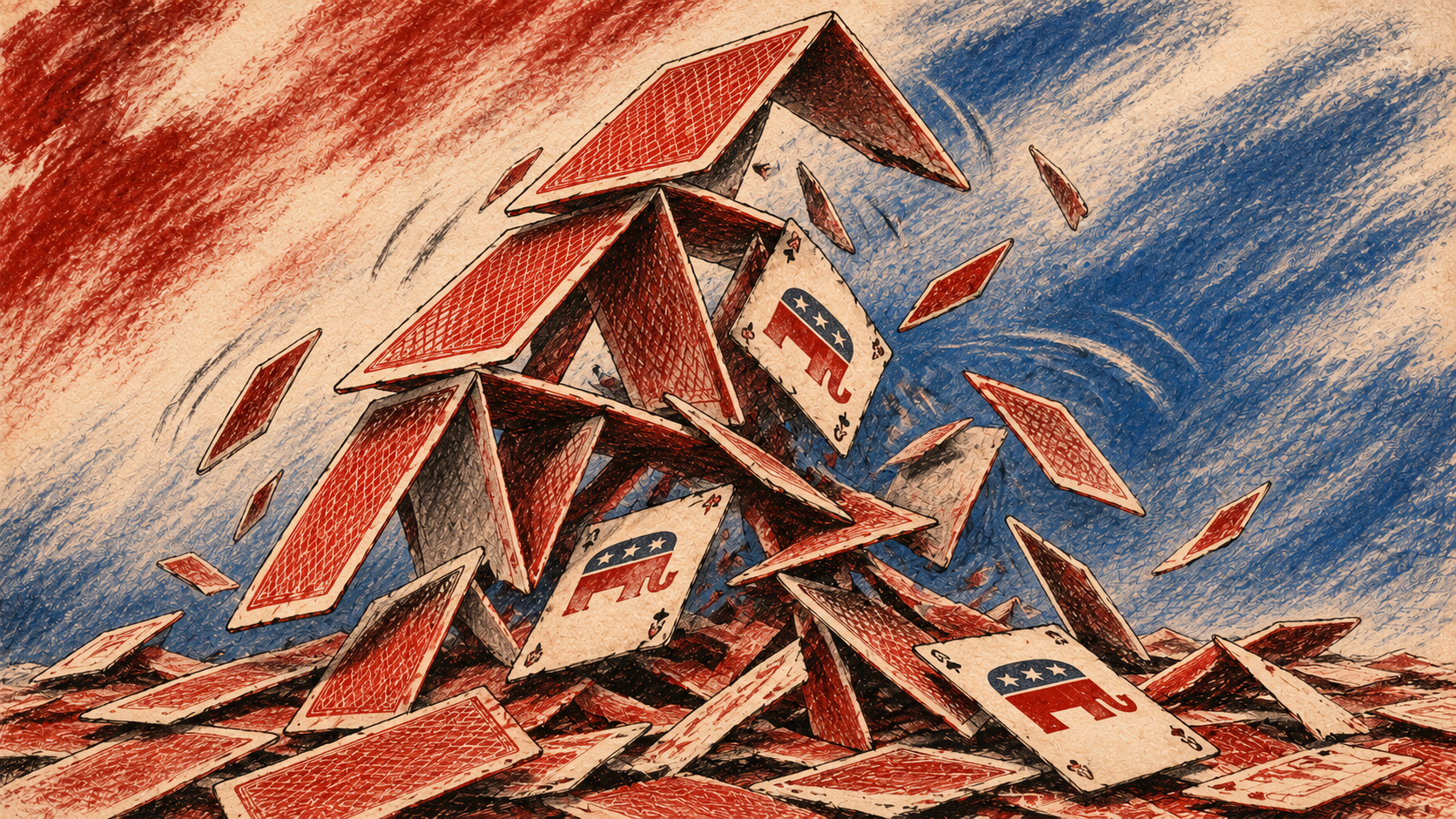
Trump’s house of cards has lost Congress. The defeat is political before it is procedural.
Democratic control of both chambers turns a midterm rebuke into institutional power. The consequences depend on what Congress can prove, block and build.
The FaultLine Desk · Published 8 November 2026 · Sources checked 8 November 2026
Source date: 3–4 November 2026
The Associated Press called the Senate for the Democrats on 3 November and the House on 4 November. The result removes unified Republican control of Congress halfway through Donald Trump’s second term. It is reasonable to describe the outcome as a political defeat for the president: voters changed the institutional balance. It is not evidence that his movement has disappeared, nor that every part of his agenda will automatically be reversed.
The scale of the setback lies less in a single headline than in the transfer of congressional power. Committee chairs, hearing agendas and the ability to demand documents move with control of a chamber. Legislation must now pass institutions run by the opposition. That makes scrutiny and negotiation unavoidable, even where the executive retains substantial authority.
A House of cards is an apt metaphor only if used carefully. The result exposes dependencies inside Trump’s governing project: congressional discipline, control of spending and protection from sustained oversight. One card has been removed. The presidency, federal agencies, courts and a large electoral coalition remain. Political analysis should not mistake an unstable structure for an already completed collapse.
For Democrats, victory creates a harder test than opposition rhetoric. Hearings can establish facts or become television. Subpoenas can advance accountability or dissolve into litigation. Budgetary leverage can produce specific changes or only repeated deadlines. The institutional opportunity is real, but its value will be measured through outcomes that citizens can identify.
The result also complicates foreign policy. Allies and adversaries will now read American commitments through a divided government, especially where funding, sanctions or treaty implementation require Congress. That does not make the United States incapable of acting. It makes durability more dependent on coalitions that survive a single administration.
The clearest conclusion is therefore narrower than triumphalism: Trump has suffered a decisive midterm rebuke and lost the protective architecture of unified congressional control. Whether this becomes a governing collapse will depend on evidence, legislative discipline and the administration’s response. The cards are moving; the structure is not yet on the floor.
Sources & verification
Desk analysis based on the sources above. Interpretations are identified in the text. Later developments may change this assessment.