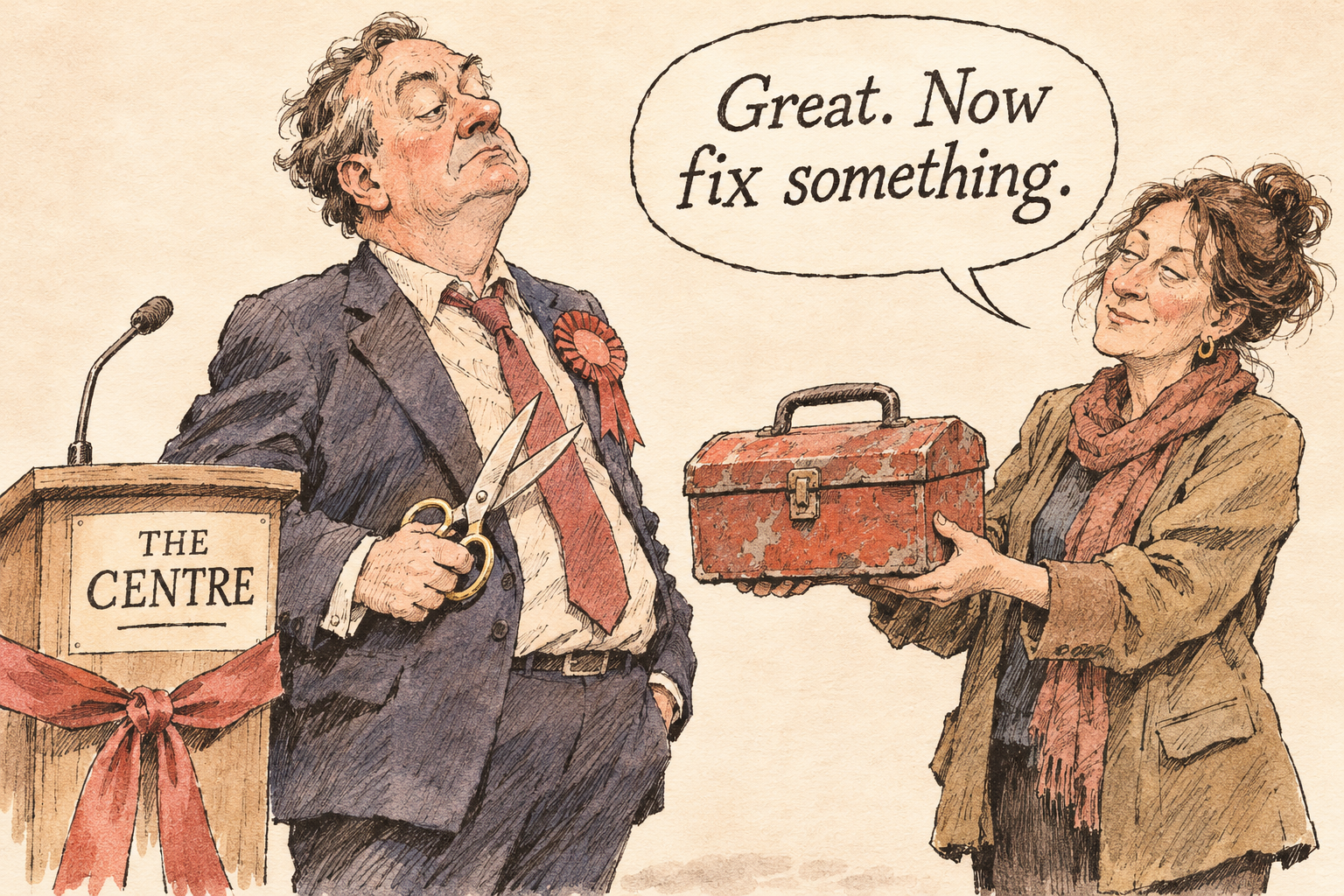
The centre needs a programme, not a sigh of relief.
After the American midterms, liberal politics must turn limits on power into a practical offer on prosperity, public services and freedom.
The FaultLine Editorial Desk · Published 5 November 2026 · Sources checked 5 November 2026
Source date: 4–5 November 2026
Associated Press reports that Democrats have won control of both chambers of Congress. Its subsequent account describes victories across the party’s ideological spectrum and a renewed argument over its direction. Trump remains president, with veto power; the incoming Congress gains the capacity to scrutinise his administration. Those are the reported facts behind this editorial. They do not settle which political programme voters want next.
The FaultLine view: a liberal centrist should welcome stronger constraints on executive power without mistaking relief for a governing philosophy. Elections are mechanisms for lending authority, subject to conditions and eventual recall. A politician who treats a victory as permission to do whatever the loudest supporters demand has misunderstood the transaction, even when those supporters happen to share our prejudices.
There is no intellectual virtue in locating oneself exactly halfway between two positions. If one side threatens judicial independence and the other defends it, the halfway point is a damaged court. If a proposal cannot be funded, describing it as compassionate does not pay the bill. Liberal centrism needs convictions strong enough to survive both partisan pressure and the awkward discovery that an opponent occasionally has a sensible idea.
The economic offer should begin with a straightforward ambition: make it easier to build a decent life. Our priorities would be more housing where people need to live, competition that allows new businesses to challenge incumbents, infrastructure that works and public services judged by access and outcomes. A market economy requires rules that protect competition; it loses legitimacy when political connections become a better investment than useful work.
Affordability deserves more than competing promises to subsidise the same shortages. Where supply can expand, governments should remove avoidable barriers to expansion. Where people need immediate protection, assistance should reach them transparently, with its cost acknowledged. Neither a tax cut nor a spending programme becomes economically serious simply because its advocates have attached the word growth to the announcement.
The same discipline applies to the state itself. Liberals should defend a capable public administration and be demanding about its performance. A right that takes years to exercise is a poor advertisement for democratic government. So is a permit that exists in law but cannot be obtained in practice. Reform means accepting responsibility for the machinery between a parliamentary vote and a person receiving the service promised.
Rights cannot become bargaining chips offered to whichever faction supplies the final votes. Freedom of expression, due process and equal treatment should protect people whose opinions we dislike as reliably as they protect our friends. Immigration policy should combine workable legal routes, credible administration and enforceable rules. The measure of seriousness is whether those arrangements can operate together, with people treated as people throughout.
For allies abroad, a congressional result is no substitute for their own capacity to act. Europe should use political breathing space to strengthen its ability to defend itself and sustain useful partnerships. Our preference is cooperation backed by capability, with clear objectives and scrutiny of the cost. Dependence does not become a strategy merely because the government on which one depends sounds more reassuring this week.
The uncomfortable test for the centre is therefore delivery. Can it open a route through a blocked housing market, improve a failing service and defend an unpopular person’s rights? Can it explain a compromise honestly and change a policy that fails? A liberal centre worth supporting must be willing to disturb comfortable arrangements. The promise should be limited power, open opportunity and institutions that earn public trust through the work they actually do.
Related analysis
- Denver exposes the Democrats’ next choice: how to use power under divided government.
- Haiti’s casualty report demands a civilian test of security.
- Colombia’s child-recruitment problem cannot be outsourced to a peace process.
- In Sudan, an attack on electricity becomes an attack on water, health and food.
Sources & verification
- Associated Press · Midterm results · 4 November 2026
- Associated Press · The debate over the Democratic Party’s future · 5 November 2026
Desk analysis based on the sources above. Interpretations are identified in the text. Later developments may change this assessment.