America votes. The world waits for the balance of power.
3 November 2026: control of Congress is on the ballot, with consequences far beyond Washington.
FAULTLINE · Desk analysis · Published 3 November 2026 · Sources checked 3 November 2026
Source date: 3 November 2026 · Pre-result analysis
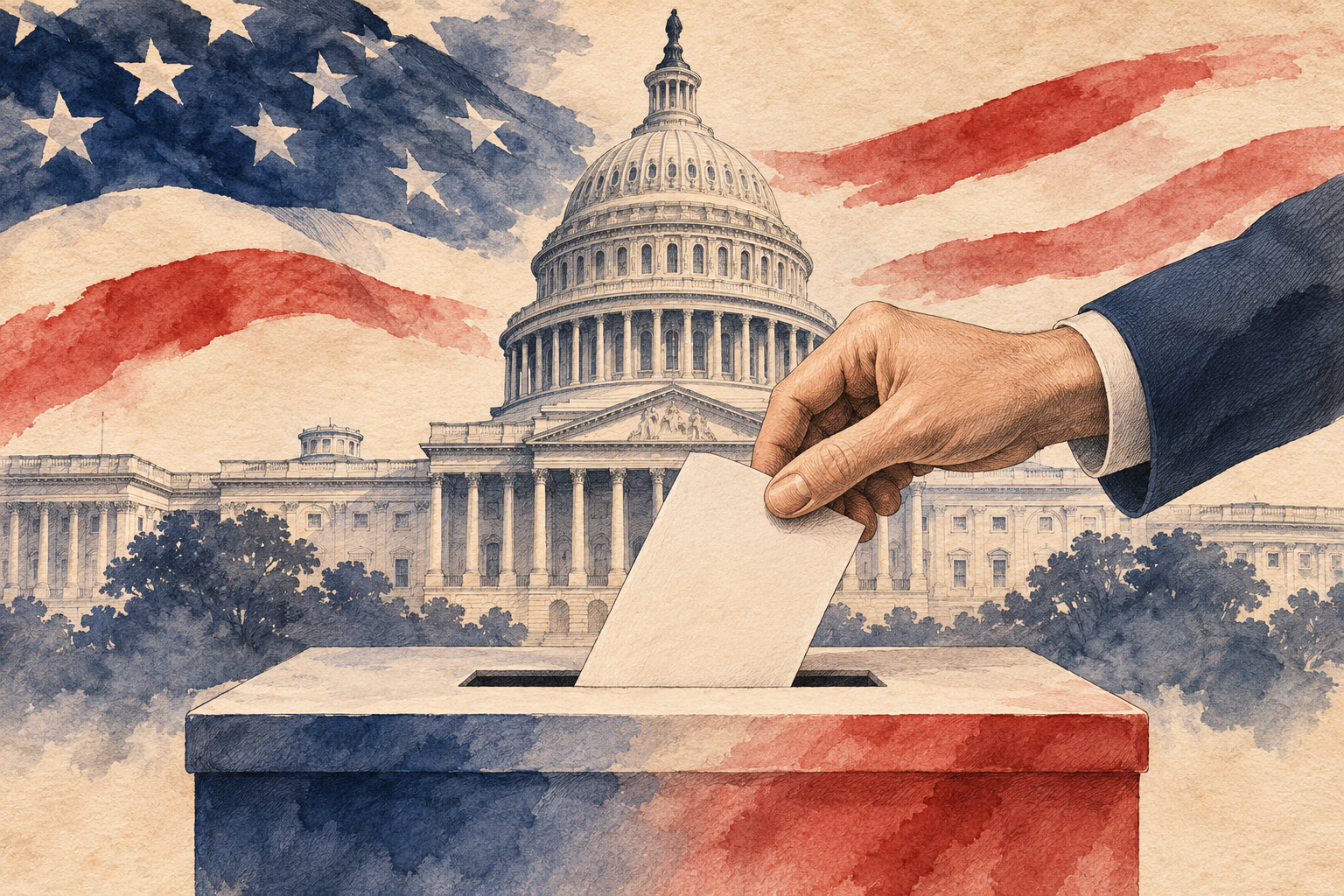
The United States votes today, Tuesday 3 November, in its midterm elections. All 435 House seats and 35 Senate seats are being contested. Reuters’ election-day assessment describes Democrats as favoured to win the House, with Senate control uncertain. That assessment is a forecast, not a result. This article is published before the outcome is known.
FAULTLINE analysis: the international importance of the vote lies in how American power is authorised, funded and scrutinised. A president can set a direction, but the composition of Congress changes the political conditions in which that direction is pursued. A shift in a chamber can alter bargaining, oversight and the prospects for legislation without automatically rewriting every element of foreign policy.
For allies, the immediate temptation will be to read the result as a simple measure of American reliability. That would be too quick. An election produces a distribution of institutional power, rather than a single instruction on every overseas commitment. Foreign governments will need to distinguish campaign positions from decisions that can command support once the new Congress takes office.
For rivals, divided government can look like an opening. Yet disagreement does not necessarily mean paralysis across all subjects. Coalitions can form around particular priorities even when the broader relationship between the legislature and the executive is confrontational. The useful questions concern specific votes, constraints and incentives, rather than a sweeping declaration that Washington has become either stronger or weaker.
There is also a democratic test that precedes the geopolitical interpretation: allowing the count to establish the outcome. Partial returns describe ballots reported at a particular moment. They do not make the remaining ballots irrelevant. A disciplined assessment should separate confirmed results, projections and unresolved races, and resist turning the speed of a count into a judgment about its legitimacy.
Today’s vote will shape the next phase of the Trump presidency. Its international meaning will emerge through what the resulting institutions actually do. Until then, the honest headline is that Americans are choosing—and the rest of the world has a considerable interest in their answer.
Related analysis
- Denver exposes the Democrats’ next choice: how to use power under divided government.
- Haiti’s casualty report demands a civilian test of security.
- Colombia’s child-recruitment problem cannot be outsourced to a peace process.
- In Sudan, an attack on electricity becomes an attack on water, health and food.
Sources & verification
Desk analysis based on the sources above. Interpretations are identified in the text. Later developments may change this assessment.